
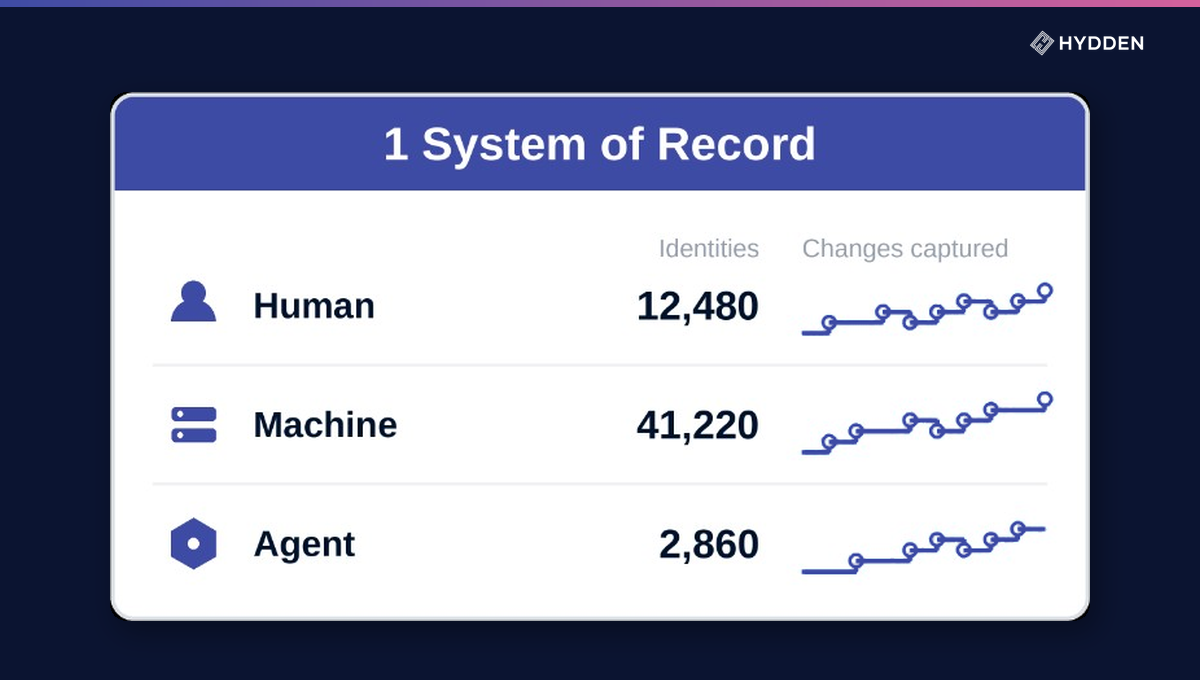
Ask sales where the customers live and you get the CRM. Ask a finance team where the numbers live and you get one answer. The general ledger. Ask HR where the people live and you get the HRIS. Nobody argues about it, because all the related systems are reconciled into a system of record.
Ask an identity team where the identities live and you get a list of systems. Entra or Okta for workforce authentication. SailPoint or Saviynt for what access is supposed to look like. A vault for the privileged credentials somebody got around to onboarding. AWS, Azure and GCP for the roles that live inside major clouds. A few hundred or even thousands of applications with their own local accounts, their own groups and their own admins. HR knows the humans, but not the machines.
Every one of those is a source of truth. Your IdP is the source of truth for how people authenticate. Your IGA is the source of truth for what was requested and approved. Your vault is the source of truth for the credentials inside it. HR is the source of truth for who still works here. None of that needs replacing.
What is missing is the place they all feed into. Each source of truth answers for its own domain, and no single one of them can answer a question that crosses domains or looks backward in time. Who could reach this database on the third of March, and through what path? Every system in the stack can tell you something about today. Reconstructing a Tuesday in March means stitching exports back together by hand, assuming the data still exist.
Is the John Smith in the HR feed the same John Smith holding a break-glass account in three clouds, a local admin account in a finance application, and a personal access token in a Git repo? Six systems will happily return the name. Nothing in the stack will tell you whether that is one person or four.
The symptoms get separate budgets
Because there is nowhere for those answers to live, every program has to go build its own partial version of the estate before it can start. That is where the cost actually shows up.
Application onboarding takes a quarter and connections break a sprint after it finishes. Access reviews certify whatever the connector managed to return. Privileged accounts show up in a scan and then stall for weeks because nobody can say who owns them. An account compromise alert turns into two days of reconstruction across four consoles with the SOC team.
Those get treated as four problems with four owners and four line items. They are the same problem showing up in four places, and no amount of tuning the individual tools closes it because what each of them is missing is a system of record to build on.
What Hydden is
Hydden is the Identity System of Record. We collect identity data from any system across human, machine and agent identities. Accounts, users, groups, entitlements and the activity against them. We collect it, resolve it into normalized entities, and keep it accurate as things change.
Your sources of truth keep their authority and keep doing their jobs. Your IGA stays complete after the onboarding project ends. Your PAM program gets a privileged inventory it can trust. Your SOC analysts get identity context on the alert rather than a scavenger hunt.
Hydden also acts on the record directly. Our access reviews automate the noise away so you just review anomalies. Joiner, mover and leaver work from what a person actually holds rather than what the provisioning path happens to know about. Accounts get routed to the right decision automatically, whether that is the vault, a rights reduction, or provisioning new accounts. Where you have a gap, Hydden fills it, but wherever you already have a system that does one of those well, Hydden feeds it. Either way you end up building the program you actually need on top of one record, rather than assembling it out of whatever each individual tool can see.
What's next on your roadmap assumes the record exists
The next round of projects on your list makes this foundational gap expensive to defer. Your near term roadmap likely includes implementing or improving automated remediation, continuous compliance evidence, or governance for AI agents. Everything else in the enterprise got its system of record first and built its programs second. Identity has been doing it in the other order for twenty years, which is a reasonable explanation for why the programs keep stalling in the same places.
Identity finally has a system of record. The programs you build on top of it can move faster and more autonomously than ever before. To see what that record looks like built from your own systems, book a demo.
Frequently asked questions
What is an identity system of record?
It is the place every identity source feeds into, holding accounts, users, groups, entitlements and the activity against them across human, machine and agent identities, resolved into normalized entities and kept accurate as things change. Sales has the CRM, finance has the general ledger, and HR has the HRIS. Identity has had a list of systems instead.
Doesn't my identity provider or IGA already serve as the source of truth?
Each of those is authoritative for its own domain. The identity provider is the source of truth for how people authenticate, the IGA for what was requested and approved, the vault for the credentials inside it, and HR for who still works here. None of them needs replacing, and none of them can answer a question that crosses domains or looks backward in time.
What questions can the identity stack not answer today?
Anything historical or cross-domain. Who could reach this database on the third of March, and through what path. Whether the John Smith in the HR feed is the same John Smith holding a break-glass account in three clouds, a local admin account in a finance application, and a personal access token in a Git repo. Six systems will return the name, and nothing in the stack will say whether that is one person or four.
What does a missing system of record actually cost?
Every program has to build its own partial version of the estate before it can start. Application onboarding takes a quarter and the connections break a sprint later, access reviews certify whatever the connector returned, privileged accounts stall for weeks because nobody can say who owns them, and a compromise alert turns into two days of reconstruction across four consoles. Those get funded as four problems with four owners, when they are one problem appearing in four places.
Does Hydden replace the identity tools already in place?
No. Your sources of truth keep their authority and keep doing their jobs. Hydden collects and resolves the data into one record, then either fills a gap or feeds the system you already run that does that job well. Access reviews, joiner-mover-leaver work and account routing then run off the record rather than off whatever each individual tool can see.
Why does the identity system of record matter now?
The next round of projects assumes it already exists. Automated remediation, continuous compliance evidence and governance for AI agents all depend on a record that is complete and current. Every other domain in the enterprise got its system of record first and built its programs second, and identity has been doing it in the other order for twenty years.