
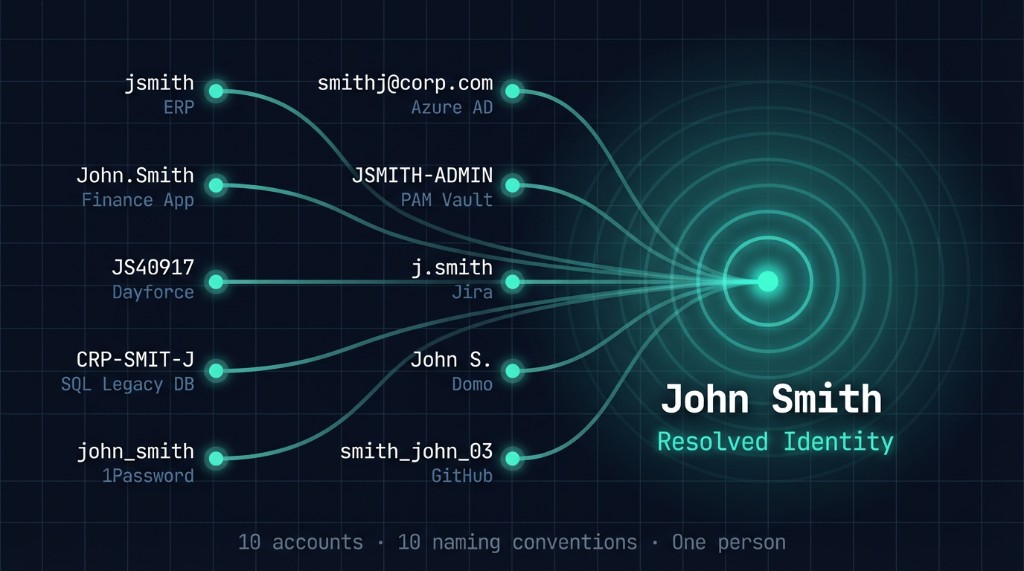
Can you map every account in your environment to the human who owns it? If you can't, everything you build on top of that, access reviews, SoD, privileged access visibility, offboarding, runs on incomplete data.
Most governance platforms say they handle this. They ship pre-built connectors with a handful of matching rules (email, employee ID, UPN) and move on. That works fine when the application fits the connector template. It stops working the moment you hit legacy systems, non-standard naming conventions, or applications that were never designed with identity integration in mind. The accounts that those connectors can't map just get skipped.
The problem isn't a lack of connectors. It's a lack of flexibility. You need to connect to any system, pull whatever metadata your security stack requires, and build mapping logic that reflects how your environment works in practice, not how a vendor assumed it would work.
That's why Hydden starts with a Universal Collector for these apps. It connects to any application: SQL databases, Oracle backends, SaaS platforms, legacy ERP systems, and in-house tools that have never had an integration point. AI discovers which fields contain identity-relevant data, surfaces the appropriate schemas to store the data in Hydden, and fast-tracks the entire collection and mapping process. No waiting on vendor connector roadmaps. No writing custom scripts for every edge case.
That's the foundation and here's why it matters...
What Mapping Actually Looks Like
Here's a snapshot from real deployments we’ve seen in the field, where dozens of systems house critical account metadata that needs to be normalized into a common schema:
Workday is the authoritative source for employee identity owners. Microsoft Entra ID is the authoritative source for vendors, but only when the Employee ID field equals a specific value. Two systems, two sources of truth, two different rules for determining who "owns" an account.
From there, it gets more complex. Delinea maps accounts using Account Name with a first-last name match. SAP can use either Display Name or Account Name. Tableau stores the account name as first-space-last. ServiceNow uses Display Name. Oracle requires a field-level adjustment: the username field actually contains only part of the display name.
Each application may follow its own convention, but all accounts should map back to a common owner across these disparate data sources. Each one requires its own mapping logic.
Then there's a legacy estate. 15 different SQL database instances spread across the world using older naming conventions. All of these require unique mapping rules before normalizing the data could even be achieved
Now imagine scripting rules for all of this.
Why Teams Skip This
Because until now, the only option was manual.
When out-of-the-box rules don't cover a system, the choices are: write a custom script, manually maintain a lookup table, or leave those accounts unmapped and move on. Under deadline pressure to get an access review out the door, most teams move on or exclude the application from scope.
The result: access reviews that cover 60-70% of accounts cleanly, with the rest orphaned, misattributed, or rubber-stamped. SoD analysis runs against usernames instead of resolved identities, which means two accounts owned by the same person get treated as two separate people, and the conflict never gets flagged. Offboarding that revokes the accounts you know about and hopes for the best on the rest.
AI Changes the Economics of Getting This Right
The mapping problem has simply been too operationally brutal. Every system has identity data somewhere in its schema. The challenge is finding the right fields, understanding each system's naming conventions, and correlating accounts across dozens of sources where the same person shows up differently everywhere.
That's exactly the kind of problem AI can help solve.
When Hydden's Universal Collector connects to a system, AI automatically discovers which fields contain identity-relevant data. It finds where the usernames live, how roles and groups are defined, and how permissions are structured. The Universal Collector surfaces the identity data that matters and normalizes it into a single data model automatically.
Then comes the step that used to take months and still never got finished. AI-driven correlation takes every account across every connected system and resolves them to real humans. It weighs naming patterns, attribute overlap, organizational context, and behavioral signals to determine that "jsmith" in your ERP, "John.Smith" in your finance app, employee ID 40917 in Workday, and a local admin account created with a legacy site-code naming convention are all the same person.
As accounts are created, modified, and deactivated, the identity graph updates in real time.
What Changes When Mapping Actually Works
When every account resolves to a real person, the entire governance stack sharpens.
- Access reviews become meaningful. Reviewers see all accounts they recognize, tied to people they manage. The review becomes a real decision rather than a guessing game.
- Separation of duties analysis works. SoD logic operates on people, not usernames. The person creating vendors in your ERP and approving payments in your finance system under two different accounts finally gets flagged, because the system knows they're the same human.
- Privileged access becomes visible. PAM vault accounts, local admin accounts, shared credentials. All trace back to an accountable human.
- Incident response gets faster. "Who owns this account?" becomes an instant lookup, not a ticket to the identity team.
- Offboarding or position changes are comprehensive. You know every account a terminated employee held, not just the ones in your directory, because the ownership graph already exists. When a person changes their job, you have a clear understanding of the applications and roles they might need in that new position.
Every identity team knows this is the goal. The gap has always been that execution required more manual effort than any team could sustain. AI eliminates that gap.
The Foundational Point
Identity mapping is the foundation that determines whether everything built on top of it actually works. Most platforms made it too hard to follow through because they put the burden on humans to define every rule, map every field, and maintain every correlation manually.
Hydden built the AI-native platform that does it automatically. Clean, complete, and continuous. So teams can stop skipping the step that makes everything else work.